Tai chi walking starts before you take a single step. It starts with how you stand. Your stance sets the quality of every movement you will practice later. Poor alignment creates tension. Good alignment creates ease. Today you build the base for the entire thirty day course.
This first day stays simple on purpose. You do not walk. You do not rush. You learn how to place your body in a position where balance feels stable and breathing feels natural. When alignment improves, effort drops. This lesson supports every future drill.
What Standing Alignment Means
Standing alignment means stacking your body in a way where weight moves downward into the ground. Bones support the structure. Muscles stay soft. You feel stable without stiffness.
In tai chi walking, alignment allows smooth weight transfer. Without it, stepping turns heavy and uneven. Knees take stress. Hips lock. The upper body tenses. Correct standing alignment prevents these problems before they appear.
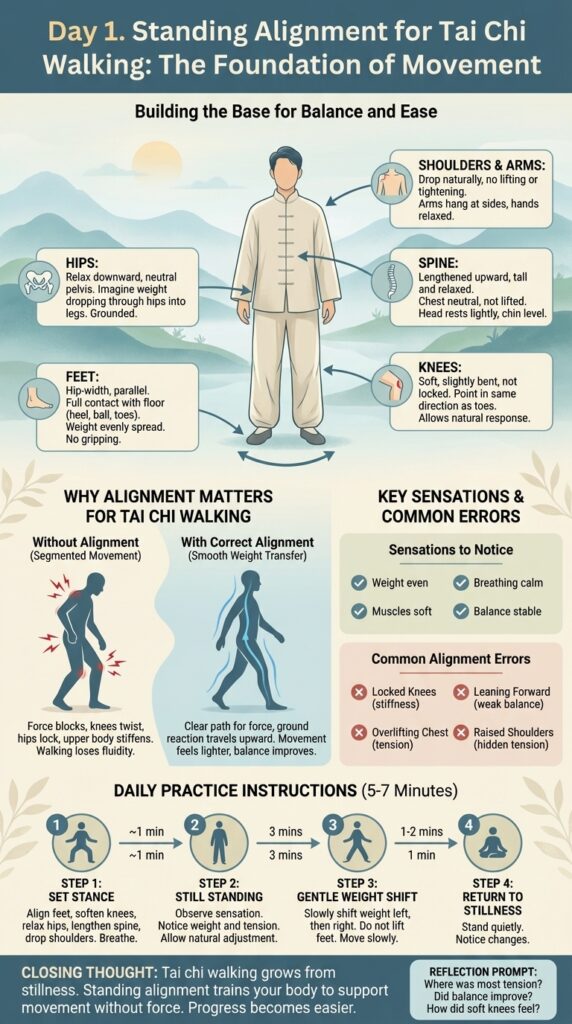
How to Set Your Stance
Start by placing your feet on the floor. Stand upright. Do not force posture. Let your body settle.
Feet
Place your feet about hip width apart. Keep them parallel. Avoid turning toes outward. Feel full contact with the floor. Heel, ball, and toes all touch the ground.
Let your weight spread evenly across both feet. Do not lean forward or backward. Do not grip the floor with your toes.
Knees
Soften your knees slightly. Do not lock them. Locked knees block weight flow and reduce balance. Soft knees allow your body to respond naturally.
Keep your knees pointing in the same direction as your toes. If knees collapse inward, strain increases. Check alignment often.
Hips
Let your hips relax downward. Avoid tucking hard or arching the lower back. The pelvis stays neutral.
Imagine weight dropping straight down through the hips into the legs. This creates a grounded feeling without tension.
Spine
Lengthen your spine upward. Do not lift your chest high. Do not slump. Find a middle position where your back feels tall and relaxed.
Your head rests lightly on top of your spine. Chin stays level. Avoid jutting the head forward.
Shoulders and Arms
Let your shoulders drop. Release any lifting or tightening. Arms hang naturally at your sides.
Hands stay relaxed. Fingers curve softly. No gripping.
Why Standing Alignment Matters for Tai Chi Walking
Tai chi walking relies on smooth weight transfer. Weight moves from one leg to the other without force. Alignment allows this to happen.
When alignment fails, movement becomes segmented. The body compensates. Knees twist. Hips lock. Upper body stiffens. Walking loses fluidity.
Correct alignment creates a clear path for force. Ground reaction travels upward through the legs and spine. Movement feels lighter. Balance improves.
Many beginners try to fix walking without fixing stance. This leads to frustration. Standing alignment solves problems early.
Key Sensations to Notice
During practice, pay attention to sensation instead of appearance. How standing feels matters more than how it looks.
- Weight feels evenly distributed
- Breathing stays calm
- Muscles feel soft, not limp
- Balance feels stable without effort
If you feel strain, pause. Reset your stance. Small adjustments create big changes.
Common Alignment Errors
Locked Knees
Locked knees block weight flow. They create stiffness and reduce balance. Always keep a small bend.
Leaning Forward
Leaning shifts weight into the toes. Balance weakens. Bring weight back toward the center of your feet.
Overlifting the Chest
Raising the chest too much tightens the back and shoulders. Let the chest stay neutral.
Raised Shoulders
Tension often hides in the shoulders. Scan them often. Let them drop naturally.
Daily Practice Instructions
Set aside five to seven minutes. Choose a quiet space. Stand barefoot if possible.
Step 1. Set Your Stance
Place your feet hip width apart. Align toes forward. Soften knees. Relax hips. Lengthen spine. Drop shoulders.
Take a few slow breaths through the nose. Let your body settle.
Step 2. Still Standing
Stand for three minutes. Do nothing else. Observe sensation.
Notice where weight rests in your feet. Notice muscle tension. Do not correct too much. Allow adjustment to happen naturally.
Step 3. Gentle Weight Shift
Slowly shift weight toward the left foot. Do not lift the right foot. Only shift weight.
Return to center. Then shift to the right foot. Keep head level. Keep spine tall.
Move slowly. Repeat for one to two minutes.
Step 4. Return to Stillness
Return weight to center. Stand quietly for one more minute. Notice any change in sensation.
How This Prepares You for Walking
Standing alignment teaches awareness. You learn how weight moves. You learn where tension hides. This awareness transfers directly into stepping later.
When you begin walking in future days, each step starts from this stance. Alignment does not change when movement begins. It carries forward.
Students who rush past standing often struggle later. Those who spend time here progress faster.
Reflection Questions
After practice, pause for a moment. Answer these questions quietly or in writing.
- Where did you feel the most tension while standing
- Did your balance improve after a few minutes
- How did softening the knees affect your posture
No right answers exist. Awareness matters more than evaluation.
Practice Tip
Return to this stance throughout the day. Stand this way while waiting. Stand this way before walking. Repetition builds familiarity.
Closing Thought
Tai chi walking grows from stillness. Standing alignment trains your body to support movement without force. Spend time here. Progress becomes easier.